Sales forecasting methods are ways of estimating how much revenue your team will close in a coming period. The five in common use are historical, weighted pipeline, sales cycle length, rep judgment and multivariable (often AI-assisted) forecasting. A small B2B team gets the most accurate number by combining two of them: a weighted pipeline forecast built from your CRM, checked against each rep's own commit.
Most guides list a dozen methods and leave you to pick. This one tells you which to use, when, and what data each needs.
The five methods at a glance
| Method | What it uses | Good for | Needs |
|---|---|---|---|
| Historical | Last period's sales, plus growth | Steady businesses with repeat revenue | 12+ months of clean sales history |
| Weighted pipeline | Open deals × chance of closing by stage | B2B teams with a defined pipeline | Consistent stages and deal values in a CRM |
| Sales cycle length | How long deals usually take to close | Teams with predictable deal timing | Created and closed dates on past deals |
| Rep judgment (commit) | Each rep's call on their own deals | Any team, as a check | Honest reps and a clear definition of "commit" |
| Multivariable / AI | Many signals at once | Larger teams with lots of data | Hundreds of past deals and clean activity data |
1. Historical forecasting
Take what you sold in the same period last year or last quarter, then adjust for growth.
Example: you closed $120,000 last quarter and have grown about 10% a quarter. This quarter's historical forecast is roughly $132,000.
It's quick and needs no pipeline data. The problem is that it assumes the future looks like the past. A new product, a lost big client or a new rep breaks it. Use it as a sense check, not your main number.
2. Weighted pipeline forecasting
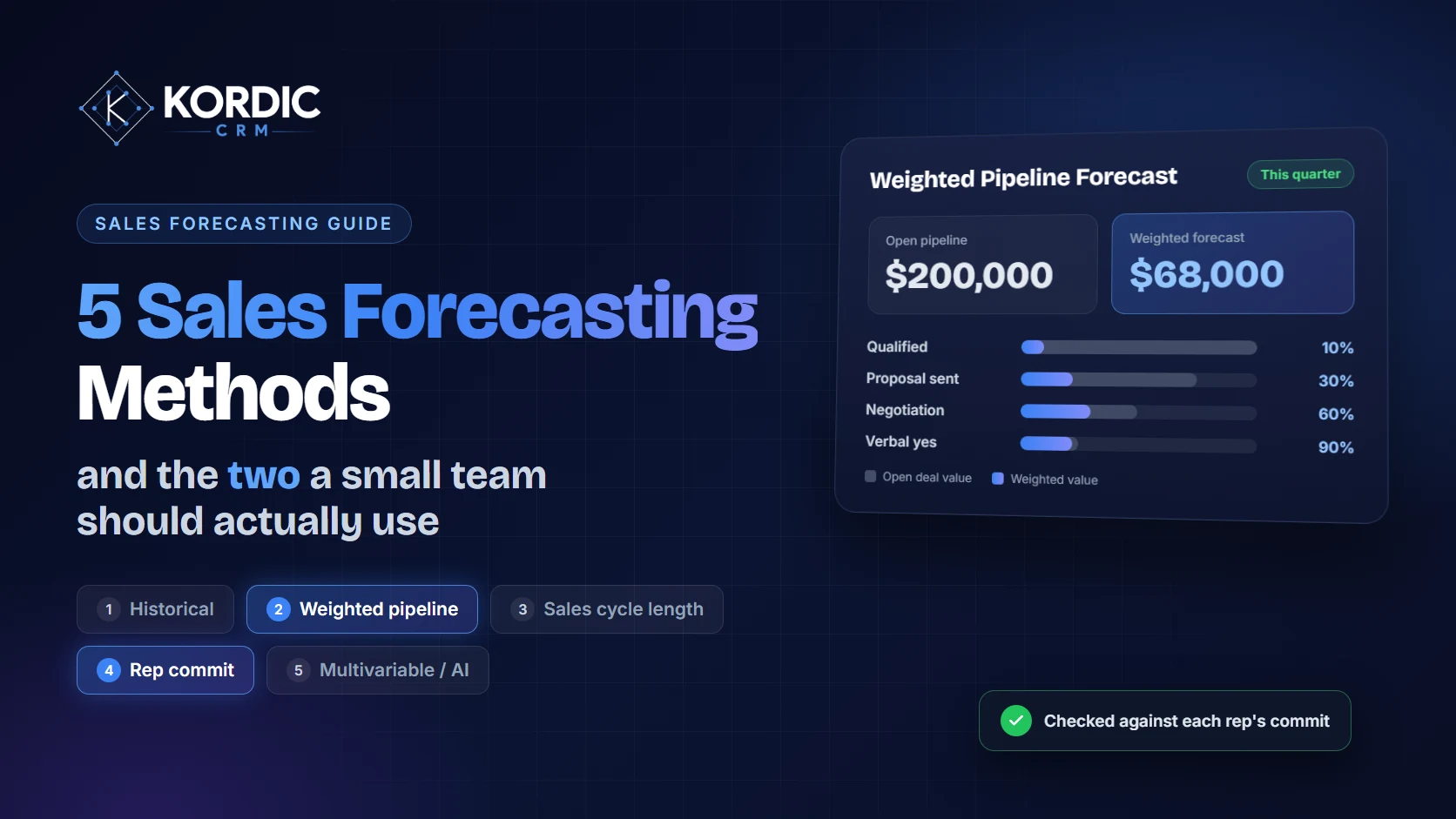
This is the method most B2B teams should build their forecast on. Every open deal is multiplied by the probability of closing at its current stage, then the results are added up.
Example:
| Stage | Close probability | Open deal value | Weighted value |
|---|---|---|---|
| Qualified | 10% | $80,000 | $8,000 |
| Proposal sent | 30% | $60,000 | $18,000 |
| Negotiation | 60% | $40,000 | $24,000 |
| Verbal yes | 90% | $20,000 | $18,000 |
| Total | $200,000 | $68,000 |
The pipeline shows $200,000, but the forecast is $68,000. That gap is the point: it stops you planning around deals that probably won't close.
The catch: the percentages have to come from your own history, not a template. If 30% of your "proposal sent" deals closed last year, use 30%. If you don't know yet, start with a reasonable guess and correct it every quarter.
What breaks it: stages that mean different things to different reps. If one rep moves a deal to "proposal sent" when they email a price, and another waits for a formal document, the percentages are meaningless. Write down what each stage means. Our guide to sales pipeline management covers how to define stages.
3. Sales cycle length forecasting
This method looks at how long a deal has been open compared with how long your deals usually take.
Example: your deals usually close within 45 days. A deal that has sat at "proposal sent" for 120 days is much less likely to close this quarter than one that's 20 days old, even though both are at the same stage.
Use it to adjust the weighted forecast. Deals far past your normal cycle length should be discounted or removed.
4. Rep judgment (the commit)
Ask each rep: "Which of your deals will close this period?" Their answer is their commit.
Reps know things the CRM doesn't, like a budget freeze or a champion who just left. They're also optimistic. Rep judgment works best as a check on the weighted number, not a replacement for it. When the two numbers differ a lot, that's a conversation worth having.
5. Multivariable and AI forecasting
These models combine many signals: stage, deal age, email activity, meeting count, deal size, rep history. Done well, they can be more accurate than any single method.
They need a lot of clean data to work, usually hundreds of closed deals with consistent records. For most teams under 25 people, the data isn't there yet. AI tools are still useful for spotting risk, such as a deal with no activity in three weeks, even when they can't produce a reliable forecast on their own.
The two-method forecast for small teams
For a team of roughly 3 to 25 sellers, this is enough:
- Build the weighted pipeline number from your CRM every week.
- Remove or discount stale deals that are well past your normal cycle length.
- Ask each rep for their commit on the same deals.
- Compare the two. Where they differ by a lot, review those deals together.
- At the end of the period, check your forecast against what actually closed, and adjust your stage percentages.
Step 5 is the one most teams skip, and it's the one that makes the forecast better over time.
What most teams get wrong
Forecasting from a pipeline nobody updates. A weighted forecast is only as good as the deal data behind it. If reps update deals once a month, the forecast is a month out of date.
Using template percentages forever. A "30% at proposal" figure copied from a blog is a starting point, not your number.
Counting a deal as won when it's signed, not paid. For cash planning, a signed deal whose invoice hasn't gone out is still a forecast, not revenue. We cover this gap in the quote to cash process.
Forecasting in Kordic
Kordic includes sales forecasting built on your pipeline, alongside multi-pipeline support and AI lead scoring. The forecast is weighted off your own stage data, so it improves as your stage history builds up. Because quotes, invoices and payments sit on the same deal, you can see which forecast deals have actually turned into cash, not just which were marked won.
Kordic starts at $4.99 per user per month, with three months free and no card needed. Start a free trial and build your first weighted forecast from your own pipeline.
Related questions
What is the most accurate sales forecasting method?
How often should a small team forecast?
What's the difference between a sales forecast and a sales pipeline?
See how pipeline forecasting, AI lead scoring and payment tracking work in Kordic, all on the deal record your team already uses.