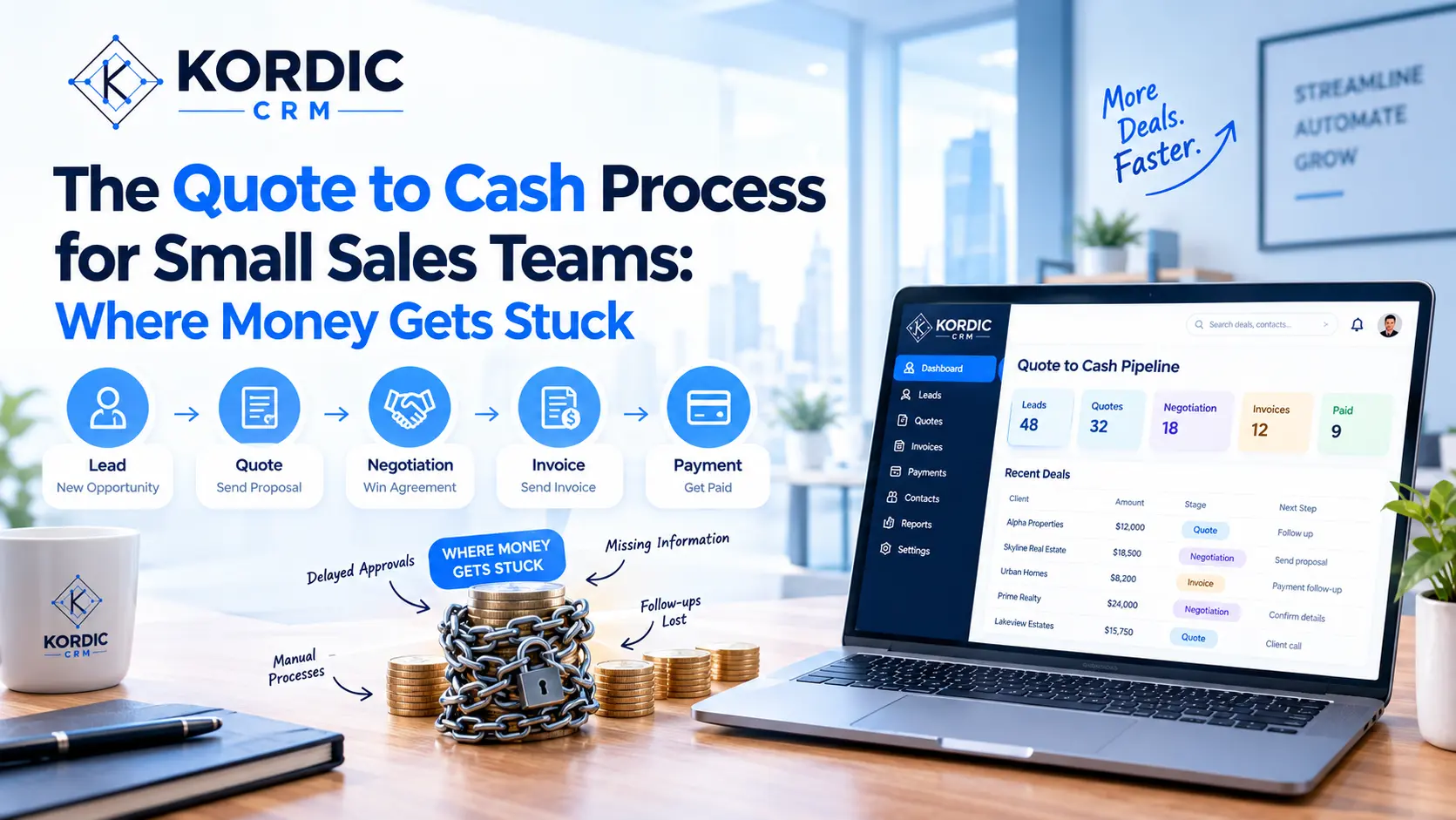
The quote to cash process is every step between sending a customer a price and having their money in your bank account: the quote, the customer's yes, the invoice, the payment, and recording that payment against the deal. Large companies split it across a CRM, a pricing tool, a contract system and an ERP. A small team usually runs it across a CRM, a spreadsheet and an inbox, and most lost revenue leaks out at the handoffs between them.
This guide is for teams of roughly 3 to 25 people who sell, invoice and chase payment themselves, without a finance department sitting behind the CRM.
What the quote to cash steps are
Most published definitions come from enterprise software vendors, so they list eight to ten stages. Stripe's guide lists eight: product configuration, pricing, quoting, contract negotiation, order management, invoicing, payment collection and revenue recognition. Conga breaks contracts into three separate steps and gets to ten.
For a small team, those collapse into five steps that actually happen:
| Step | What happens | Who usually owns it |
|---|---|---|
| 1. Quote | Price, line items, discount and tax go to the customer | Sales rep |
| 2. Acceptance | Customer says yes, by signature, email or PO | Sales rep |
| 3. Invoice | The accepted quote becomes a bill with a due date | Rep, founder or bookkeeper |
| 4. Payment | Customer pays, in full or in parts | Customer |
| 5. Reconciliation | The payment is matched to the invoice and the deal | Bookkeeper or accountant |
Configuration and pricing matter when you sell thousands of product combinations. If your price list fits on one page, they are part of step 1. Revenue recognition matters too, but it belongs in your accounting software, not your sales process.
Why small teams lose money between the steps
Each step above is simple on its own. The problem is that each one often lives in a different place.
The quote is a PDF made in a document tool. The acceptance is an email reply. The invoice is rebuilt by hand in accounting software, from the PDF. The payment arrives in the bank with a reference that matches nothing. Somebody finds out a month later that the invoice was never sent, or was sent with last quarter's price.
That gap shows up in the numbers. In Intuit QuickBooks' 2025 US Small Business Late Payments Report, a survey of 2,487 businesses with up to 100 employees, 56% said they were owed money from unpaid invoices, averaging $17,500 each. 47% had invoices more than 30 days overdue.
Not all of that is slow customers. Some of it is invoices that went out late, went out wrong, or were never followed up because nobody could see they were unpaid.
Where each step usually breaks, and the fix
Quote: the price on the quote is not the price on the invoice
When a rep builds a quote in one tool and someone else retypes it into an invoice, the two drift. A discount gets dropped. A tax rate gets applied twice. The customer disputes the invoice, and payment stops while you sort it out.
Fix: create the invoice from the accepted quote, not from scratch. If your tools cannot do that, at least keep the quote and the invoice attached to the same deal record so anyone can compare them.
Acceptance: the deal is "won" but nobody told finance
Reps mark a deal as closed and move on. The person who sends invoices finds out from a Slack message, or doesn't.
Fix: make "invoice sent" a stage in your pipeline, after "won." A deal is not done until the invoice exists. This one change makes stuck deals visible on the same board your team already checks every day.
Invoice: sent late, or sent to the wrong person
The contact who signed is often not the person who pays. An invoice sent to a sales director can sit in their inbox for three weeks.
Fix: capture the billing contact when the quote is accepted, not when the invoice is due. Add it as a required field on the deal before it can move to "invoice sent."
Payment: partial payments nobody tracks
Deposits, milestones and part-payments are normal for service businesses. They are also where records fall apart. The bank shows $4,000 received. The CRM still shows a $10,000 deal as "won." Nobody knows that $6,000 is still owed.
Fix: record every payment against the invoice it belongs to, with the remaining balance visible on the deal. We wrote more about this in common payment tracking mistakes.
Reconciliation: sales and accounting keep different records
The rep says the customer paid. The accountant can't find it. Both are partly right, because they are looking at different systems. This argument is common enough that we gave it its own post.
Fix: pick one record as the source of truth for "has this deal been paid," and make it the one both teams can see.
Do small teams need CPQ software?
Usually not. CPQ (configure, price, quote) tools are built for companies with complex product catalogs, layered discount approvals and hundreds of reps. They solve the configuration and pricing steps.
A small team's problem is rarely that pricing is too complex. It is that the quote, the invoice and the payment live in three places. A CPQ tool fixes the first step and leaves the other four exactly as broken. For a team under 25 people, a CRM that handles quotes, invoices and payment tracking on the deal itself covers more of the actual problem, at a fraction of the setup work.
If you sell configurable products with thousands of combinations, CPQ is worth a look. Otherwise, start with the handoffs.
A quote to cash checklist for this week
You can test your own process in an hour. Pick your last ten closed deals and check:
- Does every won deal have an invoice? How many days after "won" was it sent?
- Does the invoice total match the accepted quote?
- Was it sent to the person who actually pays?
- Is every partial payment recorded, with the balance still owed visible?
- Could your accountant and your sales lead agree on which of the ten are fully paid, without a meeting?
Any "no" is a place where money is waiting. The fix is almost always the same: fewer tools between steps, and one record everyone reads.
How Kordic handles quote to cash
Kordic is a CRM built around this problem. Quotes, invoices and payment records sit on the deal, so the invoice comes from the accepted quote and every payment reduces the balance on the same record the rep sees. Tax is a rate you set yourself, so it works under your own country's rules. Revenue recognition and your books stay in your accounting software.
It costs $4.99 per user per month on Starter, with three months free and no card needed. Start a free trial and run the five-question checklist above on your own pipeline.
Related questions
Is quote to cash the same as order to cash?
Is CPQ the same as quote to cash?
Who owns the quote to cash process in a small business?
See how quotes, invoices and payment tracking work in Kordic, all on the deal record your team already uses.