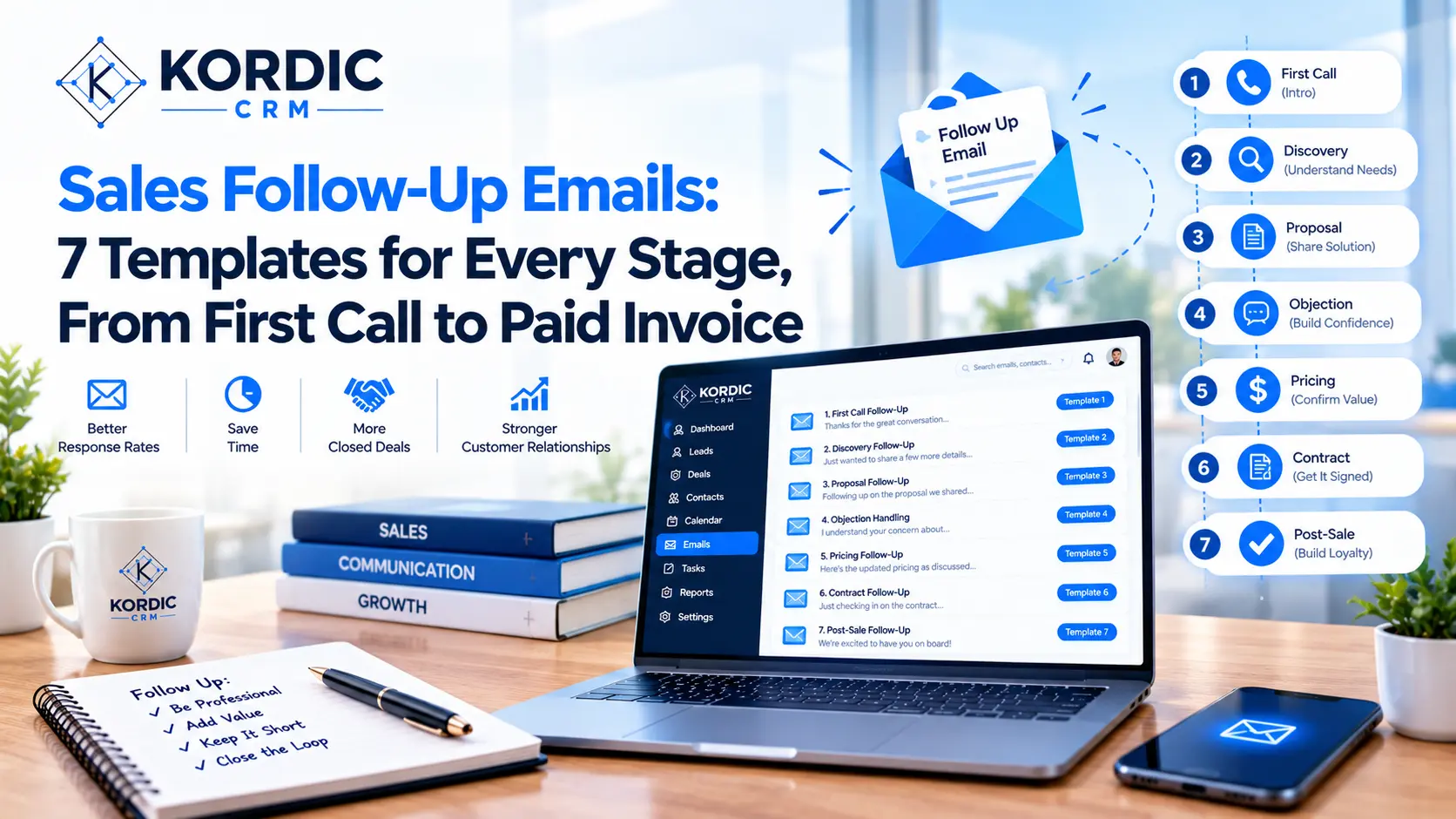
A sales follow-up email is any message you send after a conversation, demo, quote or silence to move a deal to its next step. The ones that work do three things: remind the buyer what was agreed, add something new, and ask for one specific next step. Below are seven templates, one for each point where deals usually stall, including the two most guides skip: after the quote and after the invoice.
The simple rules behind every good follow-up
- Send it the same day after any call, demo or meeting. The details are fresh for both of you.
- Lead with what they care about, not "just checking in" or "circling back".
- Add something new each time: an answer, a file, a detail they asked about.
- Ask for one thing. A time, a yes or no, a name. Not three options.
- Keep it short enough to read on a phone without scrolling.
A follow-up schedule you can actually keep
This is a starting point, not a law. Adjust it to how fast your buyers move.
| Situation | First follow-up | Then |
|---|---|---|
| After a call or demo | Same day | 3 business days if no reply |
| After sending a quote | 2 business days | 5 business days, then weekly |
| No reply to first outreach | 3 business days | 4 to 5 days, then a final note |
| Invoice sent | On the due date if unpaid | 7 days later, then a call |
Template 1: After the first call
Subject: Notes from today and next step
Hi [Name],
Thanks for your time today. Here's what I heard:
- [Problem 1, in their words]
- [Problem 2]
- You'd like to have this sorted by [date they mentioned]
As promised, here's [the thing you offered to send].
Next step: a 30-minute demo with [other person they mentioned]. Does Thursday at 2 p.m. work?
[Your name]
Why it works: the summary proves you listened, and the next step names a specific time and person.
Template 2: After a demo
Subject: The [feature] question from today's demo
Hi [Name],
You asked whether [specific question from the demo]. The short answer is [answer]. Here's [a link, screenshot or short video] showing it.
If that covers it, the next step is [trial, proposal or call with decision maker]. Want me to set that up for [date]?
[Your name]
Why it works: it answers their question instead of repeating your pitch.
Template 3: After sending a quote
This is where small teams lose the most deals, because nobody owns the follow-up. It's the first of several handoffs in the quote to cash process where money quietly gets stuck.
Subject: Your quote for [project or product]
Hi [Name],
I sent over the quote for [what it covers] on [day]. Two things buyers usually ask at this point:
- Can we start smaller? Yes, [option].
- What happens after we sign? [Next step and timeline].
Is there anything in the quote you'd like changed before you take it to [approver]?
[Your name]
Why it works: it answers the objections before they're raised, and asks what needs changing instead of "any questions?".
Template 4: No reply, first nudge
Subject: Re: [original subject]
Hi [Name],
One more thing I should have mentioned: [new, useful detail]. It might matter for [their stated goal].
Still worth a 15-minute call this week?
[Your name]
Why it works: replying in the same thread keeps context, and the new detail gives them a reason to answer.
Template 5: No reply, the honest close
Subject: Should I close this out?
Hi [Name],
I haven't heard back, so I'm guessing [project] isn't a priority right now. That's fine.
I'll close this on my side. If it comes back up, just reply to this email and we'll pick up where we left off.
[Your name]
Why it works: it's respectful, and it often gets a reply because it asks for nothing.
Template 6: After a verbal yes
Deals stall between "yes" and the signature more often than anyone admits.
Subject: Next steps to get started
Hi [Name],
Great to hear you're moving ahead. To get started on [date], I need:
- [Signed agreement or PO]
- [Billing contact name and email]
Once I have those, I'll send the invoice and [kickoff detail].
[Your name]
Why it works: it asks for the billing contact now, so the invoice doesn't go to the wrong person later.
Template 7: After the invoice, payment reminder
Subject: Invoice [number] due [date]
Hi [Name],
A quick reminder that invoice [number] for [amount] is due on [date]. Here's the link to pay: [link].
If it's already on its way, thank you, and please ignore this. If anything on the invoice looks wrong, tell me and I'll fix it today.
[Your name]
Why it works: it's polite, makes paying easy, and invites corrections early, before a dispute delays payment. Late reminders are one of the common payment tracking mistakes that quietly hurt cash flow.
About that "80% of sales need five follow-ups" statistic
You'll see it quoted on almost every follow-up guide. We looked for the original research behind it and couldn't find a published study. Treat it as folklore. The useful idea behind it is true enough: one email is rarely enough. But the right number depends on your buyer, not a statistic.
If you follow up on cold emails, know the rules
In the US, the FTC says CAN-SPAM makes no exception for business-to-business email. Commercial emails need an honest subject line, a valid postal address and a clear way to opt out, and opt-outs must be honored within 10 business days. Penalties run up to $53,088 per email. Follow-ups to people you've already spoken with are lower risk, but the opt-out rule still matters.
How Kordic keeps follow-ups from slipping
Follow-ups fail when they live in someone's memory. In Kordic, every deal shows its stage, its next step and its quote, invoice and payment status, so you can see which deals need a follow-up today, including the quotes nobody chased and the invoices nobody reminded. Kordic connects to Gmail and Outlook, so emails sit on the deal they belong to.
Kordic starts at $4.99 per user per month, with three months free and no card needed. Start a free trial and set a next step on every open deal this week.