
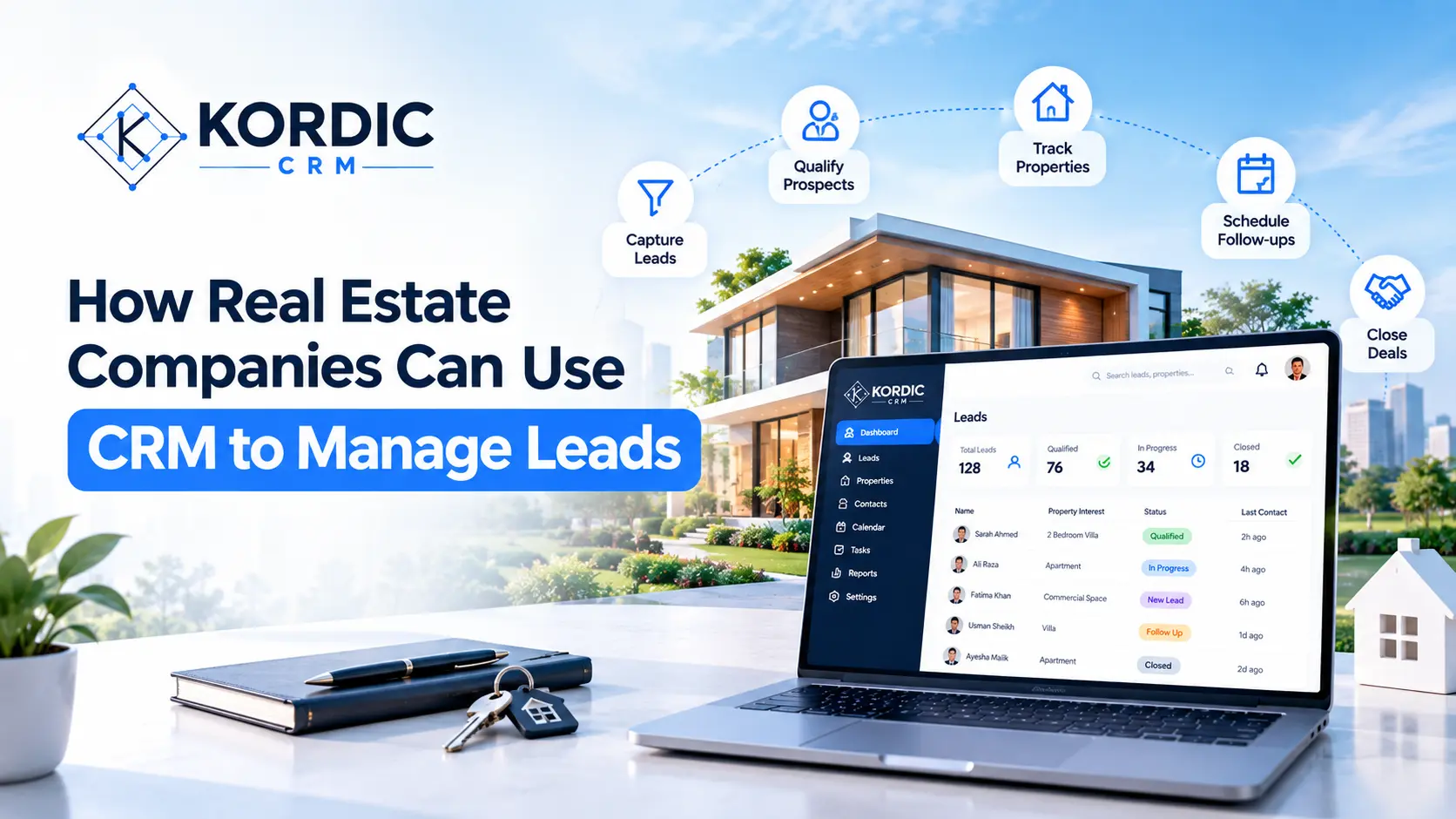
A real estate CRM manages leads by putting every inquiry into one pipeline, recording who owns each one, showing how long it has sat without contact, and firing the follow-up whether or not the agent remembers. That is the whole job. Everything else a CRM does for a brokerage is secondary to those four things.
Most brokerages already know this. They still lose leads, because the system they bought was designed around listings and the problem they have is people.
Why lead management is important for real estate companies
A lead that came in nine days ago and a lead that came in this morning look identical in a spreadsheet. Same name, same phone number, same portal tag. One of them is worth calling. The other one already spoke to two other agents and is signing with the one who called back first.
The cost is invisible, which is why it goes unfixed for years. Nobody files a complaint about the lead that was never called. It does not show up in a report. It shows up as a conversion rate that is lower than it should be and a marketing spend that looks less efficient than it is, and the usual response is to buy more leads.
Here is the part that decides whether a brokerage fixes this or not: the failure is almost never the agent being lazy. It is that thirty new inquiries arrived on Monday, nobody decided which ones matter, and the agent worked the ones at the top of the inbox. Structure is the fix. Motivation is not.
How a real estate CRM helps organize and qualify leads
Organizing leads is not the same as storing them. A shared inbox stores leads. A CRM organizes them, which means every lead has a stage, an owner, and a next action with a date on it.
Stage is where the lead sits in the buying process. For a brokerage this is usually something like New, Contacted, Qualified, Viewing Booked, Offer, Closed. Six stages is plenty. Teams that build fourteen-stage pipelines end up with leads parked in stage seven forever, because nobody agrees what stage seven means.
Owner is the one that gets skipped, and it causes more damage than the others. There is a difference between the person who owns a lead and the person currently working it. A lead can be assigned to an agent for the viewing and still belong to the team lead who is accountable for it closing. Most CRMs collapse those two into one field, so when the assigned agent goes on leave the lead has nobody. Kordic keeps lead ownership separate from assignment for exactly this reason, and it is worth checking whether whatever you are evaluating does the same.
Qualification in real estate comes down to three questions asked early: budget, timeline, and whether they are financed or paying cash. Ask them on the first call, record them as fields, and you can sort the Monday pile in about four minutes. Without them you are guessing, and guessing means working the leads that answer the phone rather than the leads that buy.
One practical rule. If a field is not going to be used to filter, sort, or trigger something, do not create it. Every optional field on a lead form is a field an agent will leave blank, and a CRM with half-empty records is worse than a spreadsheet because it looks authoritative.
Automating lead follow-ups with a real estate CRM
Speed to lead is the single most repeated statistic in real estate marketing, and the usual version of it says the first agent to respond wins the client. The underlying mechanic is not in dispute though. A buyer who fills in a form is filling in three or four, and they are talking to whoever calls back.
What automation should actually do, in order of how much it is worth:
- Route the lead the second it arrives. Portal or website form into the CRM, assigned by rule, agent notified on their phone. If this step takes a human copying an email into a system, everything after it is already late.
- Flag the leads that are going cold. A stale badge with a day counter on the pipeline card does more for follow-up discipline than any reminder email, because it is visible to the whole team on the board rather than sitting in one person's task list. Kordic shows this as a badge with the day count on the card itself.
- Send the follow-up on the channel the buyer actually uses. In practice that is WhatsApp for most markets and email for documents. A CRM that logs WhatsApp threads against the lead record is worth considerably more than one that only tracks email, because otherwise the real conversation happens on a phone nobody else can see.
- Schedule the long nurture. A buyer who is nine months out is not a dead lead, they are a calendar entry. Automated check-ins at ninety-day intervals cost nothing and recover deals that would otherwise be forgotten.
What automation should not do is send templated messages that pretend to be personal. Buyers spot it, and in a market where the transaction is the largest purchase of their life, being caught using a bot costs more than the follow-up was worth. Automate the trigger and the timing. Write the message yourself.
Using CRM data to improve real estate sales performance
Once leads run through one pipeline for a full quarter, the CRM stops being an address book and starts answering questions the brokerage could not previously answer.
The four worth tracking:
| Metric | What it tells you | What to do about it |
|---|---|---|
| Conversion rate by lead source | Which portal or campaign produces buyers rather than inquiries | Move budget. Most brokerages are overpaying for the highest-volume source |
| Time to first contact | Whether the routing is actually working | If the median is over an hour, the problem is process, not effort |
| Stage-to-stage drop-off | Where deals die | A cliff between Qualified and Viewing Booked usually means qualification is too loose |
| Average days in pipeline | How long a deal really takes for your team | Use it to forecast, and to spot the agent whose deals take twice as long |
Cost per acquired client is the number that changes decisions. Spend on a source divided by clients closed from that source, not leads generated from it. A portal that delivers 200 leads a month at a two percent close rate is worse than one delivering 40 at eight percent, and the raw lead count hides that completely.
Forecasting off this data is only as good as the stage discipline behind it. If agents move deals to Offer optimistically, the forecast is fiction. Tie the stage change to something observable, such as an offer document existing, and the number becomes usable.
How to choose the right CRM for a real estate business
Ignore the feature grids. Every CRM ticks every box on them. Pick on the axis that actually decides whether the thing gets used: how much work it takes an agent to keep a record accurate on a Tuesday afternoon between viewings.
The questions worth taking into a demo, including demos with vendors other than us:
- How does a lead get from a portal or website form into the CRM, and how long does that take with no human involved?
- Can I see, on one screen, every lead that has not been contacted in seven days?
- Are lead ownership and assignment separate fields?
- Does it log WhatsApp against the lead record, or only email?
- What does the mobile experience look like for an agent updating a deal from a car?
- What is the total monthly cost at the team size I will be at in a year, including the add-ons that are not in the headline price?
That last one catches most people. Per-user pricing that looks reasonable at five agents can quadruple at twenty, and the modules that matter are often priced separately.
One honest note about where Kordic fits. Kordic is a deal-to-cash CRM built for sales teams of roughly five to fifty people, not a real estate vertical product. It does not do MLS or IDX sync, and it does not manage property listings. If your requirement is listing syndication, buy a vertical tool. If your requirement is that thirty inquiries a week get owned, followed up, moved through stages, and then invoiced and reconciled when the commission lands, that is the part Kordic was built for. Pipelines, custom fields, lead ownership separate from assignment, WhatsApp and Gmail threads on the record, stale lead badges, invoicing and payment tracking with an accountant confirmation step, and forecasting off your own stage data.
Pricing starts at $4.99 per user per month, with a three month free trial and no card required.
Whichever tool you land on, the sequence matters more than the software. Get every lead into one pipeline, decide who owns each one, make the age of a lead visible to everyone, and automate the trigger rather than the message. A brokerage that does those four things in a spreadsheet will outperform one that does none of them in Salesforce.