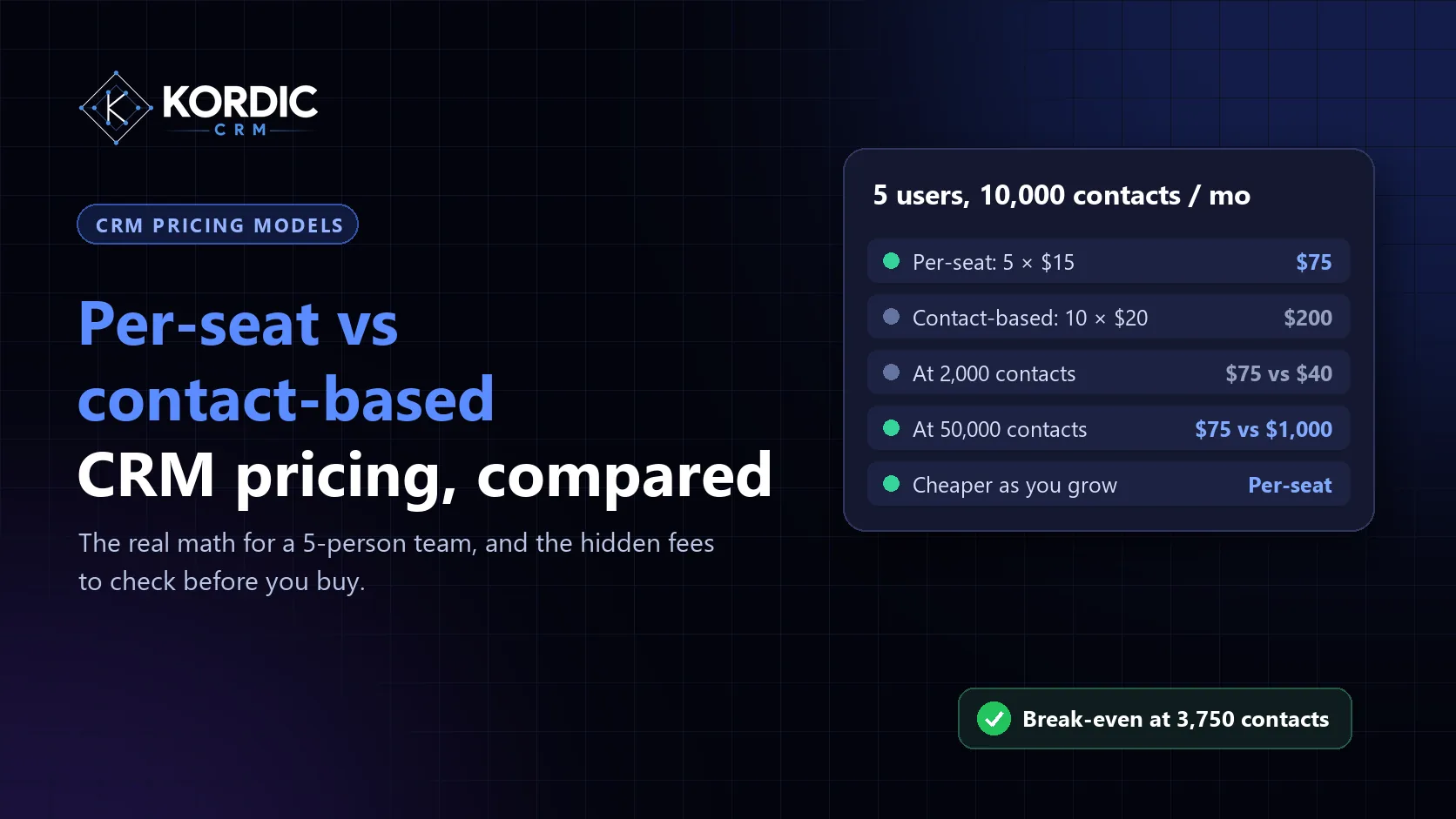
Quick answer: Per-seat CRM pricing charges for each user, so cost grows with your team. Contact-based pricing charges for the size of your database, so cost grows with your list. For most small sales teams of 2 to 20 people with growing contact lists, per-seat pricing is cheaper and more predictable. Contact-based pricing only wins when many people need access but your database stays small.
Last updated: October 2026 · By the Kordic CRM Team
Key takeaways
- Per-seat: cost = users × price. It's predictable, and contacts don't raise your bill.
- Contact-based: cost rises as your list grows, even when contacts are inactive.
- Hybrid plans charge for both, which is where most surprise bills come from.
- Run the math for your team size and contact count before you buy.
How Does Per-Seat CRM Pricing Work?
Per-seat (or per-user) pricing charges a fixed monthly fee for every person who logs in. It's the most common CRM pricing model, used by most sales-focused CRMs. A 5-person team on a $15 per user plan pays $75 a month, whether it stores 500 contacts or 50,000.
- Pros: predictable bills, unlimited growth in your database, easy budgeting.
- Cons: cost rises with every hire, and teams sometimes share logins to save money, which hurts data quality and security.
How Does Contact-Based CRM Pricing Work?
Contact-based pricing charges for the number of records in your CRM, usually in tiers such as 1,000, 5,000, or 10,000 contacts. Users are often free or cheap. This model is common in CRMs built around marketing and email.
- Pros: you can give your whole company access without paying per person.
- Cons: your bill grows with your list, and you often pay for old, inactive, or duplicate contacts until you clean them out.
What About Email-Volume and Flat-Rate Pricing?
Two other models are worth knowing. Email-volume pricing charges for how many emails you send, with unlimited contacts. Flat-rate pricing charges one fixed fee for a set number of users or features. Both can work well, but check what happens when you go over the limits.
The Real Math: Which Model Is Cheaper?
Here's a 5-person sales team on example prices: $15 per user per month for per-seat, and $20 per 1,000 contacts for contact-based. These are illustrative numbers, not a specific vendor's prices.
| Contacts | Per-seat (5 users) | Contact-based | Cheaper option |
|---|---|---|---|
| 2,000 | $75/month | $40/month | Contact-based |
| 10,000 | $75/month | $200/month | Per-seat |
| 50,000 | $75/month | $1,000/month | Per-seat |
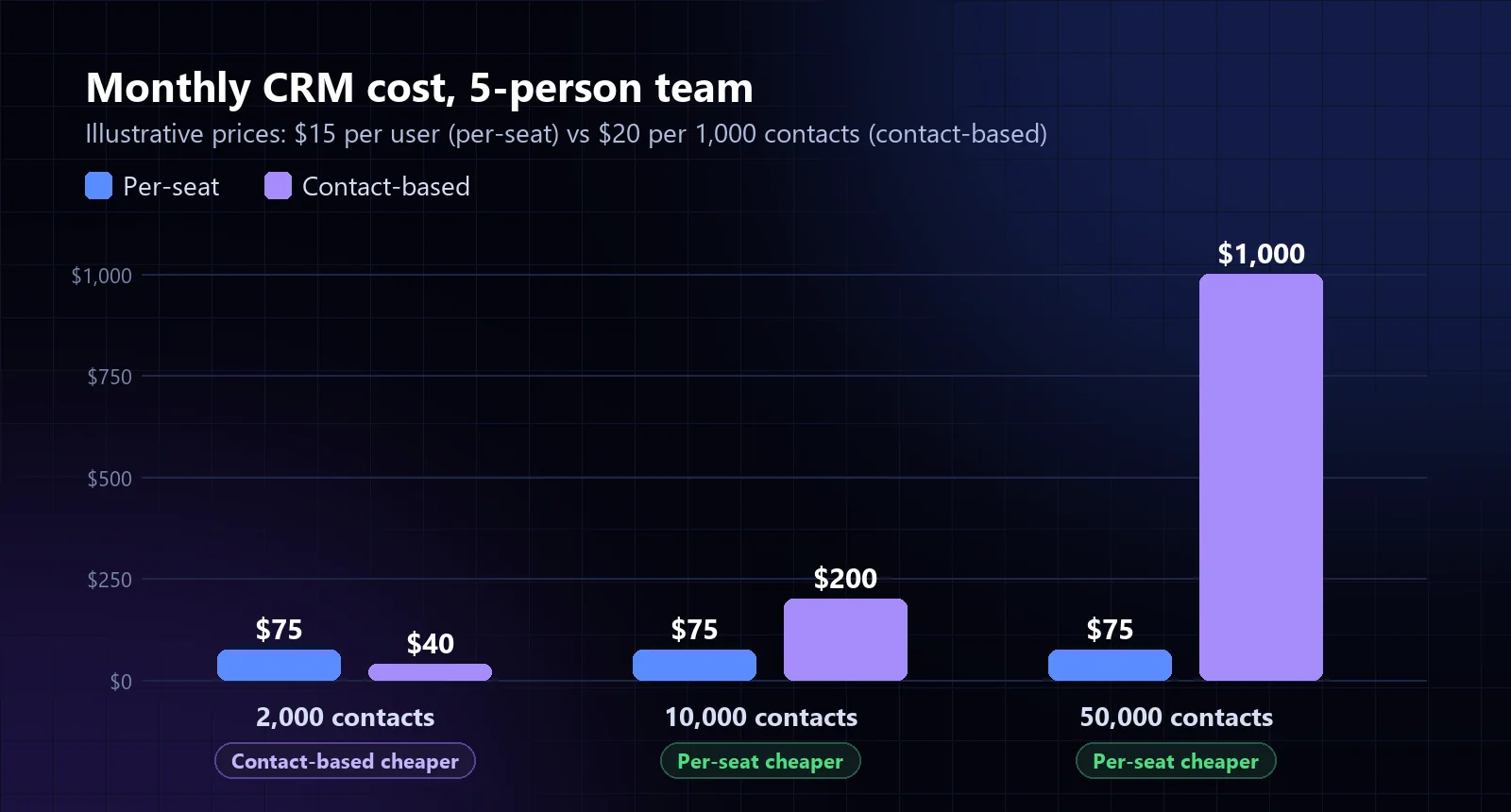
In this example, the break-even point is 3,750 contacts. Below that, contact-based pricing costs less. Above it, per-seat pricing wins, and the gap widens every time you import a lead list or run a campaign.
Team size changes the math too. A 20-person team with only 2,000 contacts would pay $300 a month per-seat but just $40 contact-based. That's why contact-based pricing suits large teams with small, stable databases, such as service businesses with a fixed client base.
The Hybrid Pricing Trap
Many popular CRMs charge for seats and contacts at the same time. HubSpot, for example, charges $250 per month for every extra 5,000 marketing contacts, while Pipedrive, Zoho, and Freshsales price per seat only. Hybrid pricing looks cheap at the start, then climbs on two fronts as you grow.
Which Pricing Model Fits Your Team?
- Choose per-seat if your team is small to mid-sized, you add leads constantly, or you want predictable monthly costs.
- Choose contact-based if many staff need access, your database is small and stable, and you clean your list regularly.
- Avoid hybrids unless you're sure your contact count will stay inside the tier you're buying.
Hidden CRM Costs to Check Before You Sign
- Onboarding or setup fees
- Seat minimums (for example, a 3-user minimum)
- Add-ons for email, chat, or lead capture
- Charges for exceeding contact or email limits
- Annual-only billing and yearly price increases
- Migration and training time
For a broader breakdown of how vendors package their plans, Capterra's guide to CRM pricing models is a useful reference.
Simple Per-User Pricing with Kordic
Kordic CRM uses straightforward per-user pricing, starting at $4.99 per user per month. Your pipeline, WhatsApp CRM, email, invoicing, and payment tracking come in one plan, so there are no add-ons to stack up (see the full feature list). Start with a 3-month free trial, no credit card required.
Related questions
What's the difference between per-user and per-contact CRM pricing?
Which CRM pricing model is cheapest for a small team?
Why do some CRMs charge for marketing contacts?
Do CRMs charge for inactive contacts?
How much should a CRM cost per user?
How do I calculate the total cost of a CRM?
Comparing real prices? See the entry prices of ten low-cost CRMs, checked on each vendor's pricing page.