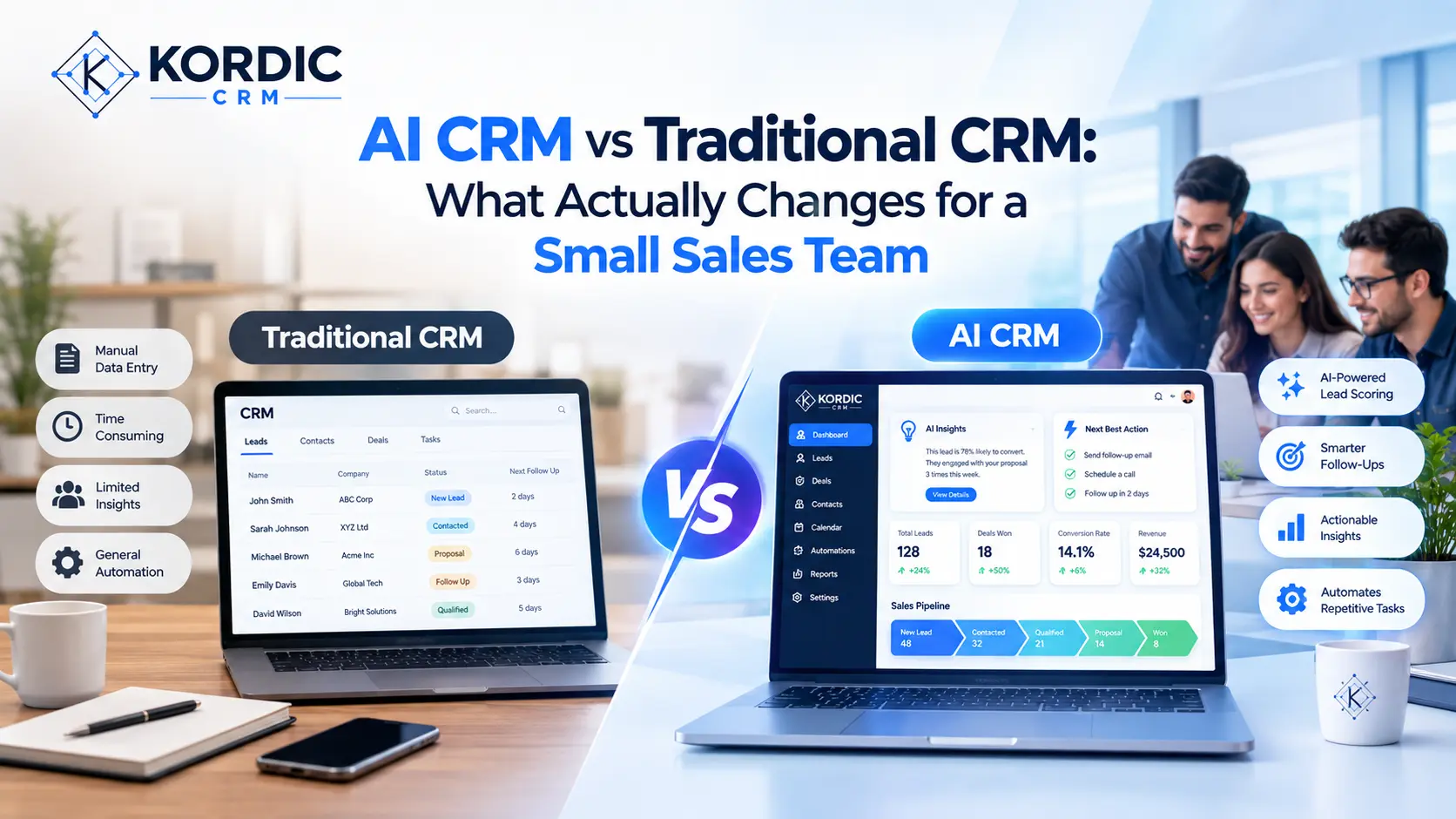
Almost every CRM on the market now calls itself AI powered, which makes the label close to useless when you are actually choosing one. Here is the real difference. A traditional CRM stores your customer data and waits for your team to act on it. An AI CRM reads that same data and does something with it: it ranks your leads by how likely they are to close, drafts the follow up email, and tells you which deals have gone quiet before anyone notices. Below is where the two actually diverge, what the research supports, and how to work out which one your business needs right now.
What a traditional CRM does
A traditional CRM is a structured database. Contacts, deal stages, notes and activity history in one place, shared across the team. It is reliable and most sales people already know how to use one.
It is also passive. It records what happened. It does not tell you what is likely to happen next, and it does not do any of the work. Every lead priority call, every follow up, every "this deal has gone cold" observation depends on a person noticing it first. That works fine until the volume outgrows the person.
What an AI CRM does differently
An AI CRM starts from the same foundation and adds a layer that acts on the data rather than just storing it. Instead of recording that a lead opened three emails and visited your pricing page twice, it uses that behaviour to rank the lead, explain the ranking, and draft the next message.
The distinction that matters more than the AI label is whether those features were designed into the system or bolted onto an older one. Kordic is built around them. Lead scoring, pre call briefings, email drafting and stale lead alerts are core screens, not add ons you configure separately.
The differences, side by side
| Traditional CRM | AI CRM | |
|---|---|---|
| Data entry | Manual | Calls, emails and meetings logged automatically |
| Lead scoring | Manual, rule based, or absent | Predictive, based on behaviour and pipeline history |
| Follow ups | Written by the rep | Drafted for the rep to approve and send |
| Forecasting | Based on rep judgement | Weighted across the full pipeline |
| Insights | You have to go looking | Surfaced to you: risk flags, stale deals, next actions |
| Call prep | Read the notes yourself | Summary, talking points and risks generated before the call |
| Setup | Lower upfront effort | Slightly higher upfront, far lower ongoing manual effort |
The short version: a traditional CRM is a filing system your team works in. An AI CRM is a system that works alongside your team.
What the research actually shows
Adoption has already tipped. As of 2026, 65% of businesses are using a CRM with generative AI features built in, and businesses using those features report being 83% more likely to exceed their sales goals, according to CRM.org's 2026 industry research. The same research found 43% of businesses say CRM software cuts employee workload by five to ten hours a week.
Treat the goal attainment figure as directional rather than causal. Companies that adopt AI tooling early tend to be the ones already investing in their sales process, so some of that gap belongs to the teams, not the software. The workload number is the one to plan around, because the hours saved on data entry and follow up writing are measurable in your own pipeline within weeks.
None of this makes a traditional CRM obsolete. If your process is simple, your lead volume is low, and you mainly need a shared record of who said what, the manual approach still works and usually costs less. The gap widens as lead volume, deal complexity and team size grow.
Lead scoring is where the gap is widest
This is the most measurable difference between the two categories. Traditional lead scoring, where it exists at all, is a static point system somebody configured once and rarely revisits. Ten points for an email open, twenty for a pricing page visit. It does not adapt, and it treats every lead the same regardless of what has actually closed for your business before.
An AI CRM scores against your own history: which behaviours, industries and engagement patterns correlate with a closed won deal for you. Kordic ranks every lead hot, warm or cool and shows the reasoning next to the score, so a rep sees "budget confirmed, CFO engaged" or "no activity in nine days" rather than an unexplained number. That reasoning is what makes the score usable. A score without it is something reps learn to ignore.
The output is a live call list ordered by who is most likely to close, updated as engagement comes in. For a team handling more leads than it can manually triage, this single feature is usually what decides the platform.
Running the CRM from a chat window
One capability worth calling out separately, because almost nobody in the small business CRM space offers it yet. Kordic CRM connects to Claude through the Model Context Protocol, which means you can ask your assistant to summarise the pipeline, pull up an account, or draft an email, and it reads and writes directly to the CRM.
The practical effect is that CRM admin stops being a separate app you have to remember to open. You ask a question in the tool you are already working in and get the answer out of live pipeline data. For small teams, where CRM hygiene usually fails because nobody wants to log in and update records, that changes the adoption problem more than any predictive feature does.
AI native platforms vs enterprise platforms with AI added
Being direct about this: Salesforce, HubSpot and the other enterprise platforms have added serious AI capability, and if you are a large sales organisation already standardised on one of them, ripping it out to move to a newer platform is rarely the right call. Migration cost alone usually eats the gain.
Where AI native platforms have the edge is setup speed, cost at small to midsize scale, and the fact that the AI is the architecture rather than a tier you upgrade into. If your team is under roughly 50 sales seats and you are not already deep into a legacy implementation, starting AI native is usually the better maths than retrofitting.
If your sales process is unusual enough that no off the shelf platform fits it, Diggit's software development team builds bespoke systems as an alternative to forcing a standard CRM to do something it was not designed for.
Is an AI CRM worth it for a small business?
For most growing small businesses, yes, with one caveat: the value scales with lead volume. If you are getting a handful of qualified leads a week, manual triage is manageable and the software matters less. Once you are fielding dozens of leads weekly across multiple channels, manual triage becomes the bottleneck, and that is the point where scoring and automated follow up pay for themselves in hours saved, before you count any lift in close rate.
The cost objection is mostly out of date. Kordic starts at $4.99 per user per month, with ten users included at $39.99 a month and twenty five at $99.99. That is below what most teams were paying for a traditional CRM with no AI in it three years ago. There is also a three month free trial with no card required, which is long enough for the lead scoring model to learn from your actual pipeline rather than showing you a demo dataset.
How to choose
- Stay on a traditional CRM if your pipeline is small, your process is simple, and cost is the binding constraint.
- Choose an AI enhanced CRM, meaning a traditional platform with AI layered in, if you are already invested in that ecosystem and mainly need better automation on top of it.
- Choose an AI native CRM if you are building your sales process from scratch or close to it, lead volume is growing faster than headcount, and you want automation as the default rather than an upgrade path.
Diggit Global has built and deployed CRM systems for clients across retail, logistics and professional services, and Kordic is the AI native platform that came out of that work. If you are weighing up whether an AI CRM fits your team, start the three month free trial and load your real pipeline into it, or book a demo and talk through your process rather than working off a generic feature checklist.