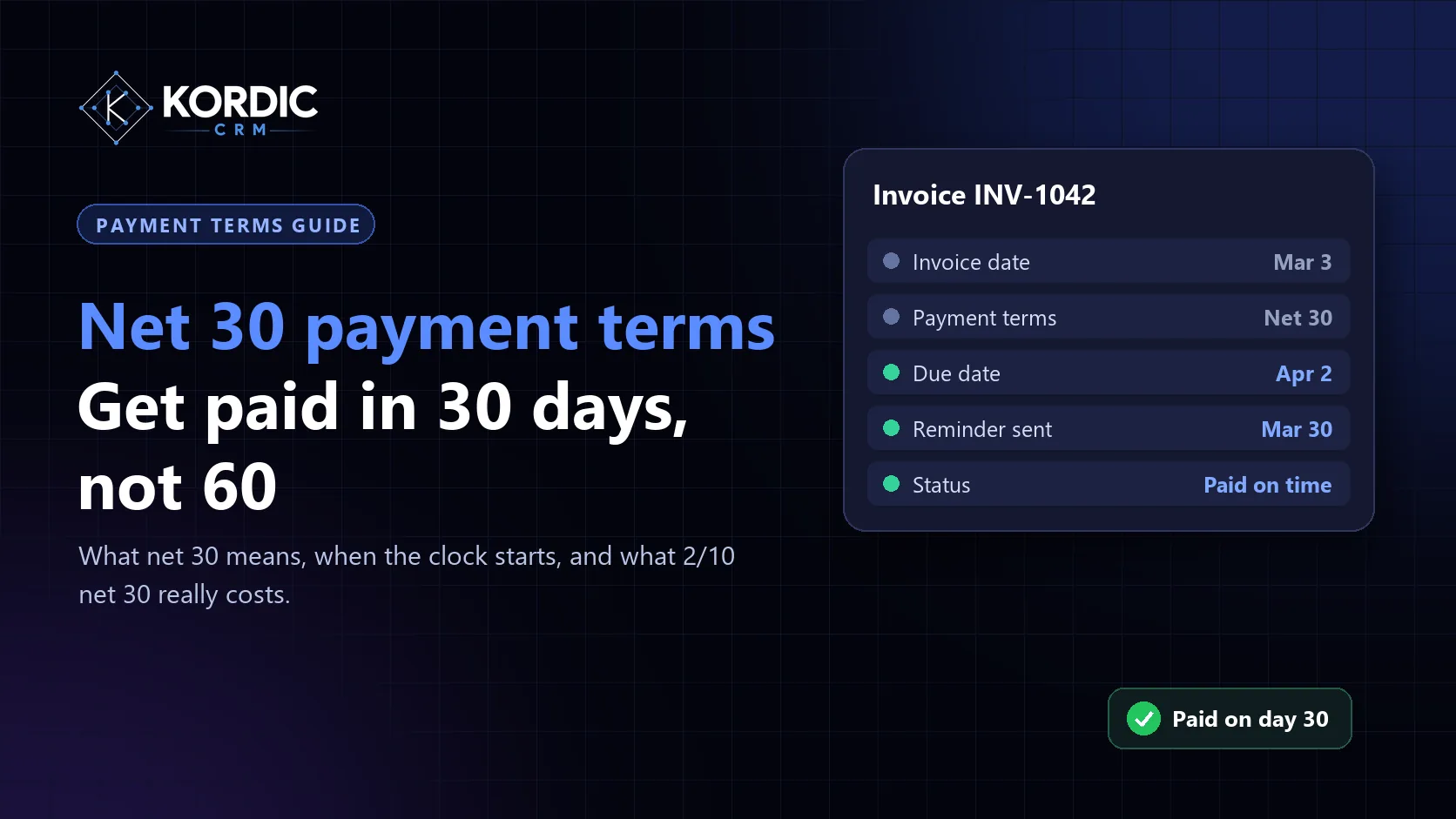
Quick answer: Net 30 means the customer has 30 calendar days from the invoice date to pay the full amount. Weekends and holidays count. It's the most common payment term in business-to-business sales, and it's a form of short-term, interest-free credit you give your customer. The catch for sellers is that 30 days on paper often becomes 45 or 60 in practice, unless the invoice is clear, sent on time, and followed up.
Published November 2026 · By the Kordic CRM Team
Net 30 and Its Common Variations
| Term | What it means |
|---|---|
| Due on receipt | Pay when the invoice arrives |
| Net 15 | Due 15 days after the invoice date |
| Net 30 | Due 30 days after the invoice date |
| Net 60 / Net 90 | Due 60 or 90 days after the invoice date |
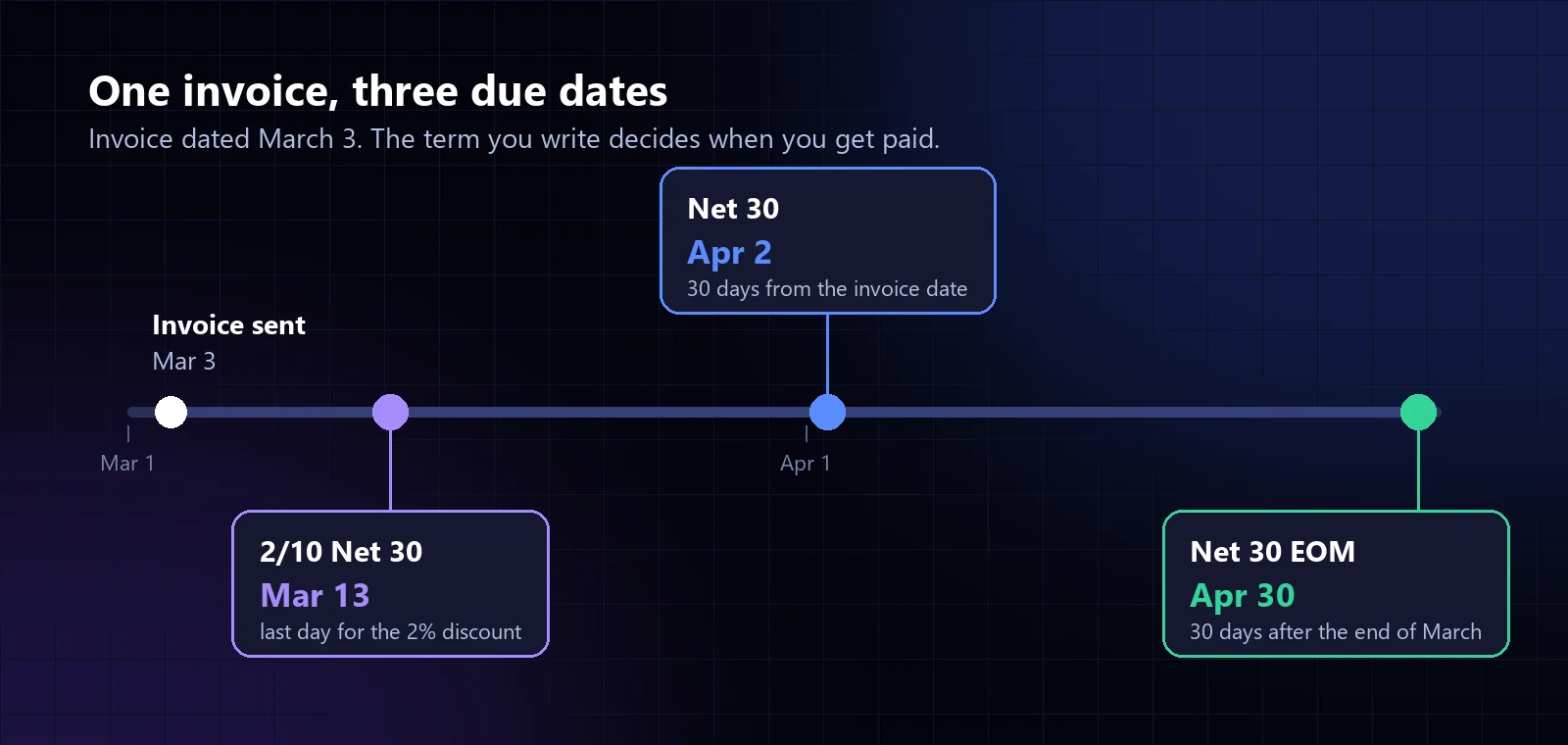
| 2/10 Net 30 | 2% discount if paid within 10 days, otherwise full amount in 30 |
| Net 30 EOM | Due 30 days after the end of the month the invoice was sent |
"EOM" matters. An invoice dated March 3 on Net 30 is due April 2. On Net 30 EOM, it's due April 30. Write which one you mean on every invoice.
When Does the 30 Days Start?
Usually on the invoice date. Some contracts start the clock on delivery or on the date the customer receives the invoice instead. If you don't say, customers will pick whichever date suits them. Put the exact due date on the invoice, not just "Net 30".
Should You Offer Net 30?
Offering terms can win business, especially with larger customers who expect them. But you're lending your customer money for a month, and some won't pay on time.
That risk is real. In Intuit QuickBooks' 2025 Small Business Late Payments Report, a survey of 2,487 US businesses with up to 100 employees, 56% said they were owed money from unpaid invoices, averaging $17,500. 47% had invoices more than 30 days overdue.
Offer net 30 when:
- The customer is established and you can check their payment history
- Your margins and cash can handle waiting a month or more
- Competitors offer terms and you'd lose the deal without them
Ask for payment upfront, or a deposit, when:
- It's a new customer with no history
- The job has large upfront costs on your side
- The amount is small enough that chasing it isn't worth the time
What 2/10 Net 30 Really Costs
An early payment discount sounds small. It isn't, for either side.
If a customer skips a 2% discount for paying on day 10 and pays on day 30 instead, they've effectively paid 2% to borrow the money for 20 extra days. Over a year, that works out to roughly 37% (2 ÷ 98 × 365 ÷ 20).
For a seller, that means a 2% discount is an expensive way to get paid faster. Use it only when cash now is worth far more to you than the 2%.
Five Ways to Actually Get Paid in 30 Days
1. Agree the terms before the work starts
Put the payment terms in the quote and the contract, not only on the invoice. A customer who agreed to net 30 in writing is easier to chase than one who first sees it on the bill.
2. Get the billing contact upfront
The person who signed is often not the person who pays. Ask for the billing contact's name and email when the deal is won.
3. Send the invoice the same day
Every day between finishing the work and sending the invoice is a day added to your wait. If net 30 starts on the invoice date, a week's delay in sending it means a week's delay in being paid.
4. Make the invoice impossible to dispute
Match it exactly to the agreed quote: same line items, same prices, same tax rate. Include the due date, your payment details and a reference the customer's accounts team can match. A disputed invoice stops the clock. We look at where money gets stuck between quote and payment in the quote to cash process.
5. Follow up before it's late, not after
A short reminder a few days before the due date catches problems early, like a missing PO number or the wrong address. Then follow up on the due date and again a week later. Our sales follow-up email templates include a payment reminder you can copy, and these common payment tracking mistakes are how overdue invoices slip through.
What to Put on a Net 30 Invoice
- "Payment terms: Net 30" and the exact due date
- Invoice number and date
- Customer's PO number, if they use one
- Line items that match the quote
- Tax shown separately
- How to pay: bank details or a payment link
- Your late payment policy, if you have one
How Kordic Helps You Get Paid on Time
In Kordic, the quote, invoice and payments sit on the same deal, so the invoice comes straight from what the customer agreed to, and every payment received shows against it. You can see which invoices are unpaid without asking accounting. Tax is a rate you set, so it works under your country's rules.
Kordic starts at $4.99 per user per month, with three months free and no card needed. Start a free trial and see every unpaid invoice in one place.